When Does Hurricane Season End? Atlantic and Pacific Dates
Direct answer: The Atlantic hurricane season officially runs from June 1 to November 30, the eastern Pacific season from May 15 to November 30, and the central Pacific season (Hawaii's region) from June 1 to November 30, according to the US National Hurricane Center. These dates are statistical boundaries, not fences: tropical cyclones sometimes form before or after them. In an average Atlantic season, major hurricanes are still forming in late October and named storms into mid-November, so October is very much still hurricane season.
The official season dates, basin by basin
- Atlantic (Atlantic Ocean, Caribbean Sea, Gulf of America): June 1 to November 30, per the National Hurricane Center.
- Eastern Pacific (from Mexico and Central America westward to 140°W): May 15 to November 30, per the National Hurricane Center.
- Central Pacific (140°W to the International Date Line, including Hawaii): June 1 to November 30, per the Central Pacific Hurricane Center, which adds that tropical cyclones can occur at any time.
The National Hurricane Center notes that tropical cyclone activity sometimes occurs before and after these dates. In Canada, the Canadian Hurricane Centre in Dartmouth, Nova Scotia uses the same June 1 to November 30 season, and it monitors the Atlantic year-round for any tropical or tropical-like cyclone that could threaten Canada or its waters.
Why the season peaks in September
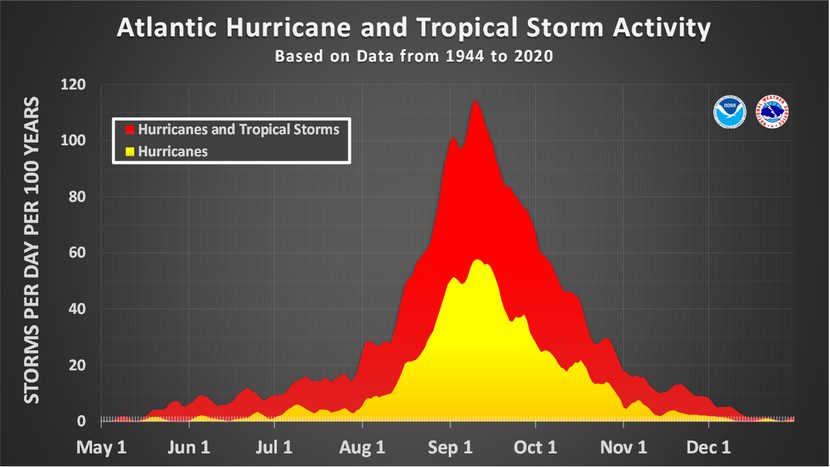
National Hurricane Center climatology, based on data from 1944 to 2020, puts the statistical peak of the Atlantic season on September 10, with most activity occurring between mid-August and mid-October. The eastern Pacific peak is less pronounced and falls in late August. The chart below shows the shape of an average Atlantic season: a sharp rise through August, the September peak, and a long tail running through October and November.
October and November storms are normal
An average Atlantic season (using the 1991-2020 climate period) produces 14 named storms, 7 hurricanes and 3 major hurricanes of Category 3 or higher. The Center's benchmarks for such a season show how late the activity runs: the third major hurricane typically forms around October 28, the seventh hurricane around November 15, and the fourteenth named storm around November 19. Late-season storms are not freaks; they are part of the average season.
Storms can also arrive after the calendar runs out. NOAA counts 89 tropical or subtropical cyclones in the Atlantic database, which dates to 1851, that formed in the off season between December and May.
What about Canada and the UK?
In Canada, the Canadian Hurricane Centre is the federal government's main point of contact with the US National Hurricane Center. During the season it runs a forecast desk around the clock whenever a tropical storm might affect Canadian waters within 72 hours, issuing public updates and maps every six hours or more often. It says hurricanes are typically of greater concern in Canadian waters later in the season; August and September see the most storms, and on average three or four tropical cyclone events affect or threaten Canada each year. Its preparedness advice: follow its hurricane bulletins, assemble an emergency kit, learn the difference between a hurricane watch and a warning, and use the WeatherCAN app.
In the UK, a tropical cyclone cannot arrive as a hurricane: the Met Office explains that hurricanes need sea surface temperatures of at least 27°C, which UK waters never reach. But dying hurricanes are still dangerous. Moving into higher latitudes, they undergo "extratropical transition" and become ex-hurricanes, with their energy source shifting from warm ocean water to the clash of warm and cold air masses, and these systems can still produce hurricane-force winds. Ex-Hurricane Ophelia struck the UK and Ireland on 16 October 2017, with the Met Office recording gusts of 60 to 70 knots or more at exposed coastal sites and 90 mph at Capel Curig in Gwynedd. Ex-Hurricane Lorenzo arrived in 2019 as a deep low-pressure system bringing very strong winds and heavy rain to western areas.
What to do: don't stand down early
The practical lesson of the season's long tail is simple: while the season is still running, keep your preparations in place. The US government's guidance at ready.gov applies anywhere tropical cyclones threaten: know your risk (hurricanes are not just a coastal problem), know your evacuation zone and routes, have several ways to receive warnings, keep an emergency kit and go bag ready, and strengthen your home before a storm threatens.
If a storm does threaten: evacuate immediately when local officials order it, and never try to ride out a storm-surge evacuation zone. If flooding traps you, go to the highest level of the building, never a closed attic. Do not walk, swim or drive through floodwater: just six inches of fast-moving water can knock you down, and one foot of moving water can sweep your vehicle away. Storm surge is the leading cause of hurricane-related deaths in the United States. After the storm, follow local officials' instructions before returning or starting cleanup.
Related pages on this site: the Hurricane Safety Guide and Storm Surge Safety Guide for full before-during-after checklists, the Tropical Cyclone Outlook for what the National Hurricane Center is watching right now, US weather alerts by state, and the history of major hurricanes.
Frequently asked questions
Can a hurricane form in December?
Occasionally, yes. The National Hurricane Center says tropical cyclone activity sometimes occurs outside the official season dates, and NOAA counts 89 Atlantic tropical or subtropical cyclones that formed between December and May since 1851.
Does hurricane season affect the UK?
Not directly: hurricanes need sea temperatures of at least 27°C, so they cannot form near or strike the UK. But their remnants can. Ex-hurricanes like Ophelia in October 2017 arrive as powerful autumn storms with hurricane-force gusts.
When is the busiest part of hurricane season?
The statistical peak of the Atlantic season is September 10, with most activity between mid-August and mid-October, based on 1944-2020 data from the National Hurricane Center.
Is it safe to stop preparing once October arrives?
No. In an average Atlantic season the third major hurricane typically forms around October 28 and named storms keep forming into mid-November, so keep plans and kits ready until the season ends on November 30.
Sources
- NOAA National Hurricane Center - Tropical Cyclone Climatology
- Ready.gov - Hurricanes
- Environment and Climate Change Canada - Canadian Hurricane Centre
- Environment and Climate Change Canada - Hurricane FAQ
- Met Office - When is a hurricane not a hurricane
- Met Office - Ex-Hurricane Ophelia
- NOAA Office of Response and Restoration - When is Atlantic hurricane season
About the author
WND Editorial Team — The World Natural Disasters editorial team curates disaster information from official scientific and humanitarian sources, reviews safety guidance against public-agency recommendations, and maintains the historical database.
Written and reviewed under our editorial policy. Factual claims cite the sources listed above.
Found an error? See our corrections policy.