Disaster alerts for the places your family lives
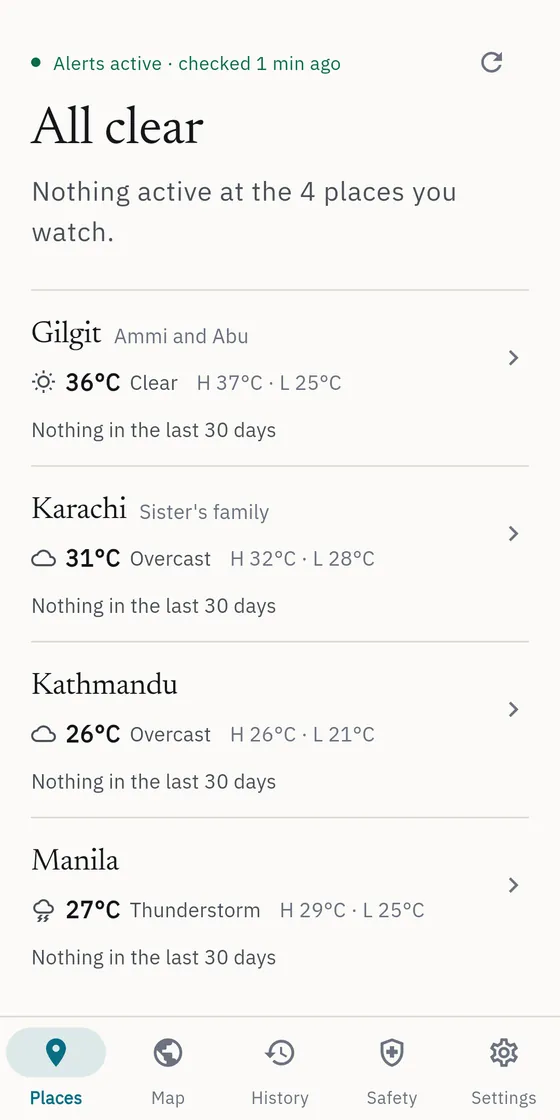
Every alert on your phone is about where you are. This one is about where the people you love are — your parents' town, your sister's city, the village you grew up in.
Free · no account · no sign-up · works offline for safety guides and emergency numbers
Why this exists
Phone-based alerts are location-bound by design. Cell broadcast, national SMS and the earthquake warning built into Android all run off the tower you are connected to, so they can only warn you about where you are standing.
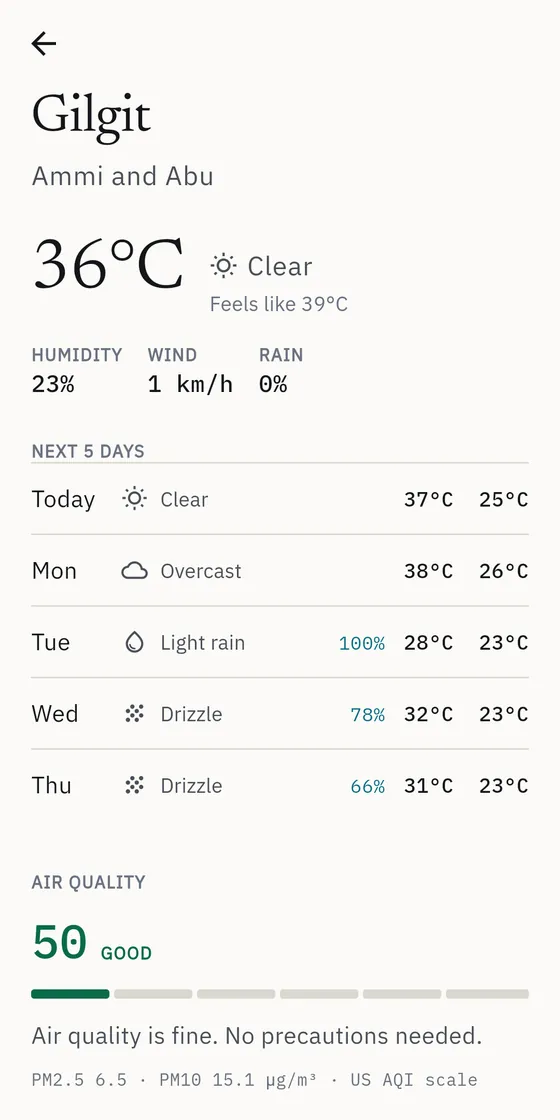
If you work in Dubai and your family is in Gilgit, no phone alert will ever tell you about Gilgit. That is the gap this app fills, and it is the only thing it is trying to do.
What it does
A watchlist of places
Add places anywhere in the world, each with its own alert radius and its own minimum severity. Stored on your phone — never uploaded, not even to a cloud backup.
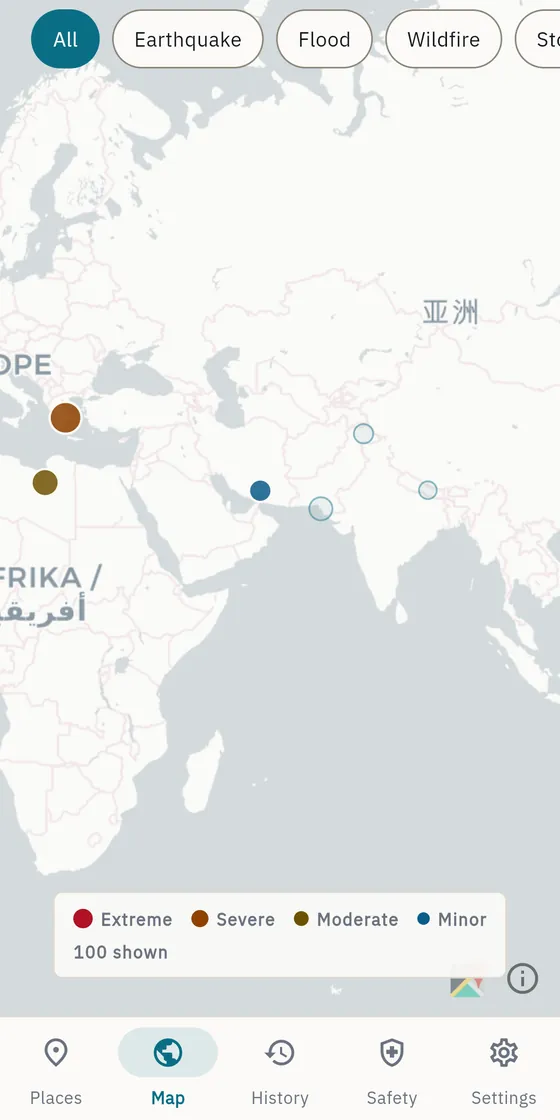
Severity in plain language
"Strong shaking, buildings may be damaged" rather than "M6.2". Severity is shown as a word and a four-segment bar before it is shown as a colour, so it still reads if you cannot distinguish the colours.
The local time there
Every watched place shows the time where it is. You know whether it is 3am before you call, and the app says so: "It is 3am there. A message now, a call when they are awake."
Weather, forecast and air quality
Five-day forecast and US-AQI air quality for every place you watch, from Open-Meteo. Smog alerts only when the air gets worse than the last thing you were told — not every day of a Lahore winter.
Works with no network
Twelve safety guides and official emergency numbers for 145 countries are bundled inside the app. They open when the connection has already gone.
Family Circle
Share a few places with your family and tell each other "I am safe" in one tap. Optional — if you never open it, nothing about you reaches our servers.
Restraint is the feature
Most alert apps drown you, and people delete them before the day that matters. MyShake sits at 3.3 out of 5, and its most common complaint is having to scroll through dozens of alerts from all over the world to find the one nearby.
- At most six ordinary alerts a day, only at severity levels you choose.
- Repeats collapse — sixty aftershocks produce one notification, not sixty.
- Quiet hours, with only extreme events breaking through.
- A small reserve behind the daily limit that only an extreme event can use, so six routine warnings in the morning can never quietly swallow a magnitude-7 earthquake that evening.
All of that is enforced in the code, not left to you to configure.
What it is not
This app aggregates public data from official agencies. It is not itself an official warning system and must not be your only source. Always follow instructions from your local authorities.
Background checks run about every fifteen minutes, which is Android's floor for background work, so an alert can arrive a few minutes late rather than instantly. The app shows you when it last checked, and says so plainly when Android has suspended it.
Absence of an event means nothing reached the feeds we read. It does not mean nothing happened.
Where the data comes from
USGS and EMSC for earthquakes, NASA FIRMS for satellite fire detection, NASA EONET, GDACS (UN and European Commission), NOAA/NWS, ReliefWeb (UN OCHA), and Open-Meteo for weather and air quality. Every event in the app links back to the agency that published it. See data sources and attribution.
Privacy
No account, no sign-up, and the app never asks for location permission — it cannot see where you are. The places you watch stay on your phone. The app is free and carries a small banner advert at the bottom of Settings and at the end of your alert history, and nowhere else: never on an alert, a map, an event, a safety guide or an emergency contact screen.
Full detail in the app privacy policy, and how to delete your data.