Tire Chains: When to Use Them and How to Fit Them
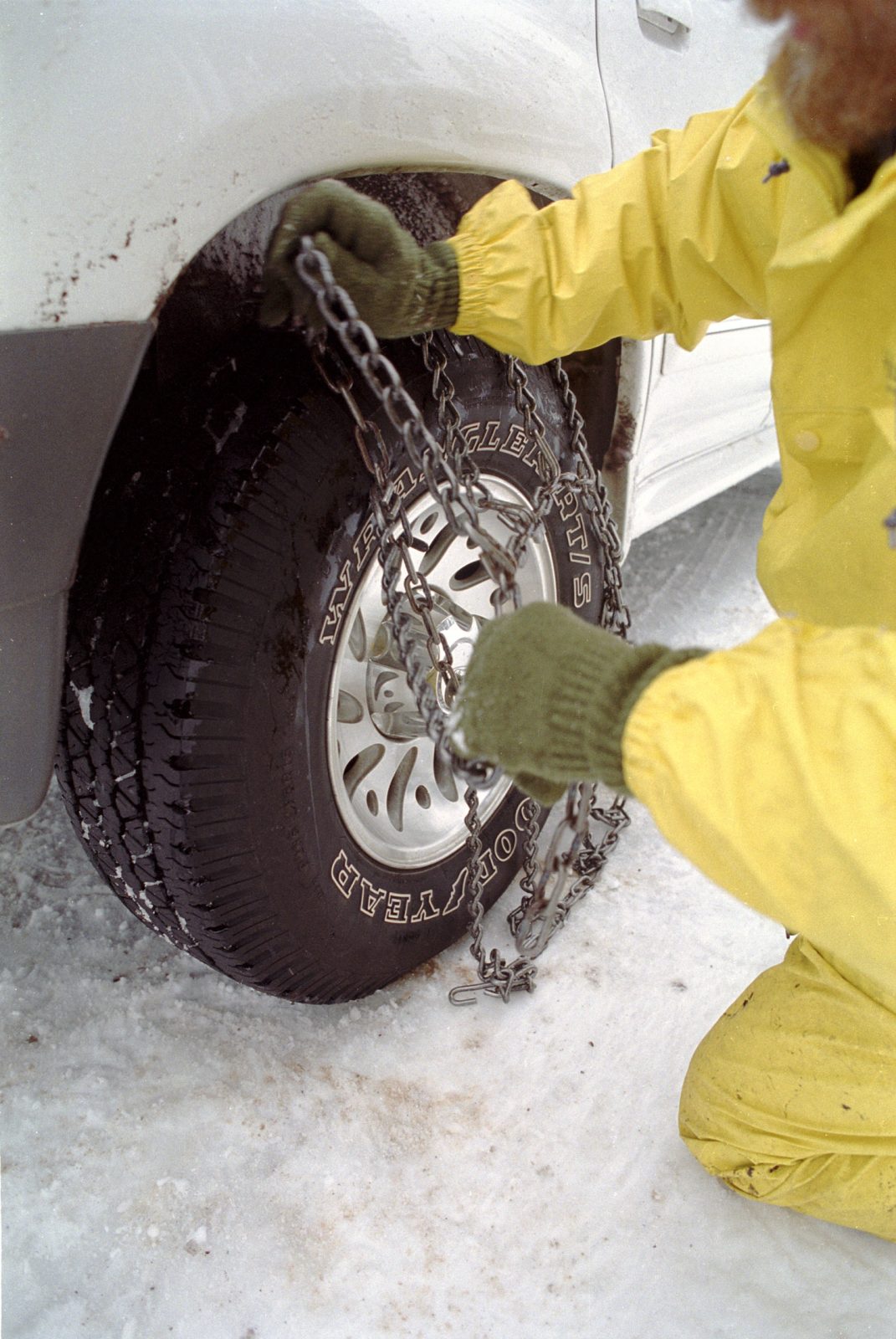
Direct answer: When the sign at the side of the road says chains are required, stop and fit them. In California and in Colorado, chains are the final step before a highway closes, and the rules differ between the two states. California uses three levels — R-1, R-2 and R-3. Colorado uses two laws — the Traction Law and the Chain Law. Wherever you drive, chains go on the drive axle and speed drops to 25 or 30 miles per hour — learn how they fit at home, not at the roadside in a storm.
What tire chains actually do
California Vehicle Code 605 defines a tire chain as a device that attaches to a wheel to improve traction, braking and cornering on snow and ice. Chains bite into packed snow and ice where a bare tire can slide. They do not make a car invincible: braking distances stay long, and the limit with chains on is 25 or 30 miles per hour in California. Check the tires first: the U.S. National Highway Traffic Safety Administration says a tire is legally worn out at 2/32 of an inch of tread — the penny test — and pressure should be checked cold, after three hours parked.
California: three levels, R-1, R-2 and R-3
California has no set dates for chain controls — they go up when the weather demands it, at one of three levels. At R-1, chains are required except on passenger vehicles and light trucks under 6,000 pounds with snow tires on at least two drive wheels — and even those must carry chains, with any trailer chained on one drive axle. At R-2, the exception is four-wheel-drive and all-wheel-drive vehicles with snow-tread tires on all four wheels — and they must still carry chains. At R-3, chains are required on all vehicles, no exceptions. A snow-tread tire is one with MS, M/S, M+S or MUD AND SNOW stamped on the sidewall. You will usually have about a mile between the “Chains Required” signs and the checkpoint: pull off the roadway to the right to fit them, and drive beyond the “End of Chain Control” signs to remove them. Current requirements: 800-427-7623 (Caltrans).
Colorado: the Traction Law and the Chain Law
Colorado runs two different laws. The Traction Law applies on Interstate 70 between Morrison and Dotsero from September 1 to May 31, and can be put in force on any state highway. Under it, tires need at least 3/16 of an inch of tread and an all-weather or winter rating — mountain-snowflake symbol or M+S marking — or you must carry chains or an approved alternative traction device. The Chain Law is stricter: when in force, every vehicle must have chains or an approved alternative device fitted — the final step before the highway is closed. Approved devices include AutoSock, EasySox, the ISSE Tire Sock and Alpha Trax. Fines: $100 plus a $33 surcharge, and $500 plus a $157 surcharge if your vehicle blocks a travel lane.
How to fit chains
Fit chains on the drive axle. On a four-wheel-drive or all-wheel-drive vehicle, either axle works, but the rear is preferred unless the manufacturer says the front. Practise the fit at home, and check the chains are the right size. Towing a trailer always means chains, and a trailer with brakes needs at least one axle chained. Cable chains are permitted for passenger cars and light trucks in California, and if your manufacturer says chains cannot be used, cable chains or a similar device such as Spikes Spider are the answer.
Carry chains even when you do not fit them
In California, a four-wheel-drive vehicle must carry chains to enter a chain control area even when fitting is not required, and a vehicle on snow tires must carry a pair too. A vehicle without chains is not permitted to enter a chain control area at all — it must turn back to a lower elevation and wait. Studded tires are allowed in California from November 1 to April 30, but they are not a substitute for chains.
The rules in France and the UK
France: chains or winter tyres by law
France’s winter equipment law, the Loi Montagne, has applied since 2021. From November 1 to March 31, in 34 mountain departments, every vehicle with four or more wheels must carry removable anti-skid devices — metal chains for frequent use, textile snow socks for occasional use — for at least two drive wheels, or be fitted with four winter tires. Only tires carrying the three-peak mountain snowflake symbol count as winter tires.
United Kingdom: no chain law, but strict winter rules
The United Kingdom has no chain law at all — it has the Highway Code. Rule 228 says do not drive in snow and ice unless your journey is essential, and to carry de-icer, an ice scraper, a torch, warm clothing and a shovel. Rule 229 says to clear all snow and ice from every window. Rule 230 warns stopping distances can be ten times greater on ice and snow, and Rule 231 says to drive slowly, in as high a gear as possible, braking very gently.
Before any winter trip, check our weather alerts page and read our cold safety guide — chains decide whether you keep moving or turn back, so carry them before you need them.
Frequently asked questions
Do I need tire chains if I have four-wheel drive?
Yes, you must carry them. In California, four-wheel-drive vehicles must carry chains to enter a chain control area. At R-2, four-wheel-drive and all-wheel-drive vehicles with snow-tread tires on all four wheels do not have to fit them, but at R-3 chains go on every vehicle with no exceptions. In Colorado, the Chain Law requires every vehicle to have chains or an approved alternative traction device fitted.
Which wheels do tire chains go on?
The drive axle. On a four-wheel-drive or all-wheel-drive vehicle, chains can go on either axle, but the rear is preferred unless the vehicle manufacturer says the front. Towing a trailer always requires chains, and a trailer with brakes needs at least one axle chained.
How fast can I drive with tire chains on?
25 or 30 miles per hour in California, according to Caltrans. Chains give you grip on snow and ice, not speed — braking distances stay long even with chains fitted.
Can I use cable chains instead of link chains?
Yes, cable chains are permitted for passenger cars and light trucks in California. If your vehicle manufacturer says chains cannot be used on your car, cable chains or a similar device such as Spikes Spider are the answer. Studded tires are not a substitute for chains.
Sources
- Caltrans - Chain Controls
- Caltrans - Chain Requirements
- Colorado Department of Transportation - Passenger Vehicle Traction and Chain Laws
- NHTSA - Winter Driving Tips
- Service-public.gouv.fr - Loi Montagne (winter equipment law)
- UK Highway Code - Driving in adverse weather conditions (226 to 237)
About the author
WND Editorial Team — The World Natural Disasters editorial team curates disaster information from official scientific and humanitarian sources, reviews safety guidance against public-agency recommendations, and maintains the historical database.
Written and reviewed under our editorial policy. Factual claims cite the sources listed above.
Found an error? See our corrections policy.