How Snowfall Is Measured: The Science Behind the Totals
Direct answer: When a snowstorm ends and the news reports that 12 inches fell, that number comes from a careful routine, not a glance out the window. The National Weather Service asks observers to measure three separate values: snowfall, snow depth, and the water equivalent of the snow. Each one answers a different question — how much new snow fell, how much snow is on the ground, and how much water that snow would become if it melted. Getting them right matters: the totals decide storm records, feed flood forecasts, and tell road crews how much work is ahead.
Snowfall: the new snow on the board
Snowfall is the depth of new snow that has fallen since the previous observation. Observers measure it on a snowboard — a flat, white board set out in an open spot away from trees, buildings, and shadows — and record the greatest accumulation since the last observation, in inches and tenths. The measurement is taken at least once a day, but it can be taken up to four times a day, every six hours — the routine National Weather Service forecast offices follow. The board is cleared after each measurement, but never more often than once every six hours, and a 24-hour total is never the sum of more than four six-hourly observations — adding more would falsely inflate the total. If snow falls in separate bursts and melts between them, the observer adds the greatest depth of each burst. If snow melts as it lands and never reaches a tenth of an inch, the snowfall is recorded as a trace, marked with a T. And freezing rain is never reported as snowfall: glaze ice is liquid precipitation, and it is reported as such.
Snow depth: everything on the ground
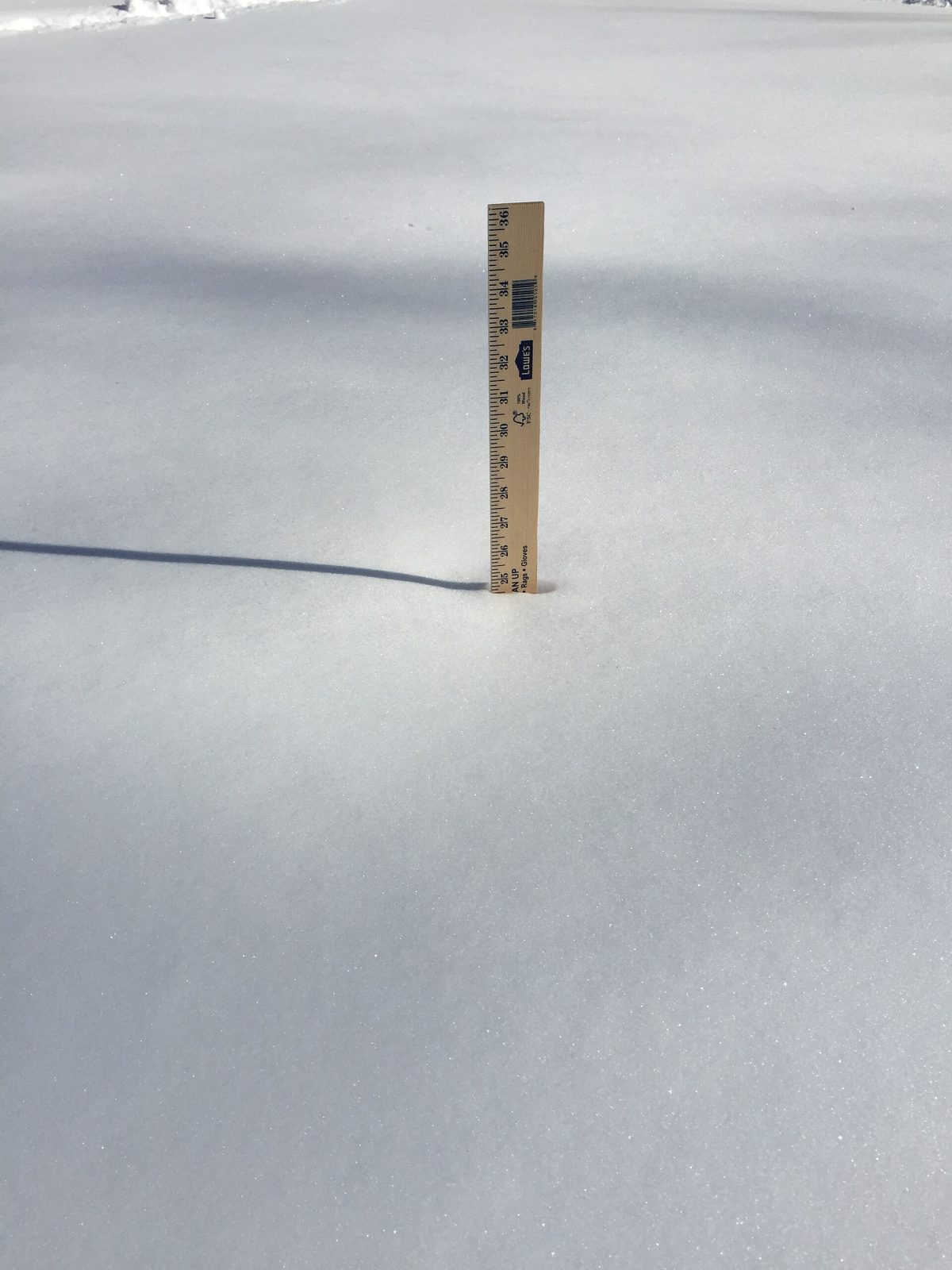
Snow depth is the total depth of snow, ice pellets, and ice sitting on the ground — old snow included. It is measured once a day with a measuring stick pushed vertically into the snow until it rests on the ground, taking the average of several readings at or near the usual observation point. It is reported to the nearest whole inch, rounding up when a half inch is reached. Observers avoid rooftops and paved areas, and they do not mistake a crust of ice for the ground. When wind has blown the snow around, they take several measurements where drifting was least and average them. In hilly country, where one slope is bare and another holds deep snow, they average what they see: if half the exposed ground is bare and half is covered with six inches, the depth is three inches. If less than half the exposed ground is covered, the depth is recorded as a trace.
Water equivalent: the water inside the snow
The third value is the water equivalent — how much liquid water the snow holds. Once a day, the observer melts the contents of the rain gauge, with the funnel and inner tube removed so the eight-inch can can catch frozen precipitation, and measures the liquid to the nearest hundredth of an inch. If warm water was added to melt the snow, its amount is measured first and subtracted from the total. Wind makes this the hardest measurement of all: as winds increase, gauges catch less of the precipitation that actually falls, and the stronger the wind and the drier the snow, the less is captured. When the gauge has caught less than the snow on the ground, the observer can cut a core — sometimes called cutting a biscuit — out of the snowboard with the eight-inch overflow can, melt it, and measure that instead.
Why totals differ from town to town
Snow measurement is an inexact science, as the National Weather Service puts it: snowfall records are the best estimates of trained observers working under difficult conditions. Wind is the biggest troublemaker — it piles snow into drifts in one spot and scours it bare in another, which is why observers measure where blowing and drifting are minimized and average several readings. The snow itself varies too. Chicago's 1967 blizzard dropped 23 inches of snow holding 2.40 inches of water, a ratio of 9.6 to 1; the 1979 storm came in at 14.9 to 1, and the 1999 storm at 15.5 to 1. The same depth of snow can hold very different amounts of water, which is why the water equivalent is measured separately. When two nearby towns report very different totals for the same storm, the difference is usually real: the snow fell unevenly, the wind moved it, and each observer measured what actually landed at their station.
What the numbers mean for you
A reported snow total is a measured total, not a guess — but it is a measurement of one place, by one observer. That is why the same storm can leave one town digging out of a foot of snow while the next town over reports half that much. If you measure at home, follow the same rules the professionals use: measure on a board or on open ground away from buildings and trees, push the stick straight down to the ground, and clear the board no more often than every six hours. And before the next storm, check the weather alerts page and the site's cold safety guidance so you know what is coming before it starts falling.
Frequently asked questions
What is the difference between snowfall and snow depth?
Snowfall is the amount of new snow that fell since the last observation, measured on a snowboard. Snow depth is the total depth of all snow on the ground, old and new, measured with a stick at the usual observation point.
Why do snowfall totals differ between nearby towns?
Snow falls unevenly and wind moves it into drifts, so totals vary from place to place. The National Weather Service calls snow measurement an inexact science: each total is the best estimate of a trained observer at one station.
What is the water equivalent of snow?
It is the amount of liquid water the snow holds. Observers melt the snow collected in a gauge and measure the liquid to the nearest hundredth of an inch. It shows how much water a snowfall will add when it melts.
Why is freezing rain not counted as snowfall?
Freezing rain is liquid precipitation that freezes on contact with cold surfaces. The National Weather Service says glaze ice should never be reported as snowfall; it is reported as liquid precipitation.
Sources
- National Weather Service - Snow Measurement Guidelines
- National Weather Service Chicago - 2011 Blizzard Storm Total Snowfall Adjusted & In-Depth Look at Chicago's Top 4 Big Snows
About the author
WND Editorial Team — The World Natural Disasters editorial team curates disaster information from official scientific and humanitarian sources, reviews safety guidance against public-agency recommendations, and maintains the historical database.
Written and reviewed under our editorial policy. Factual claims cite the sources listed above.
Found an error? See our corrections policy.