Earthquake Philippines
The 2013 Bohol Earthquake
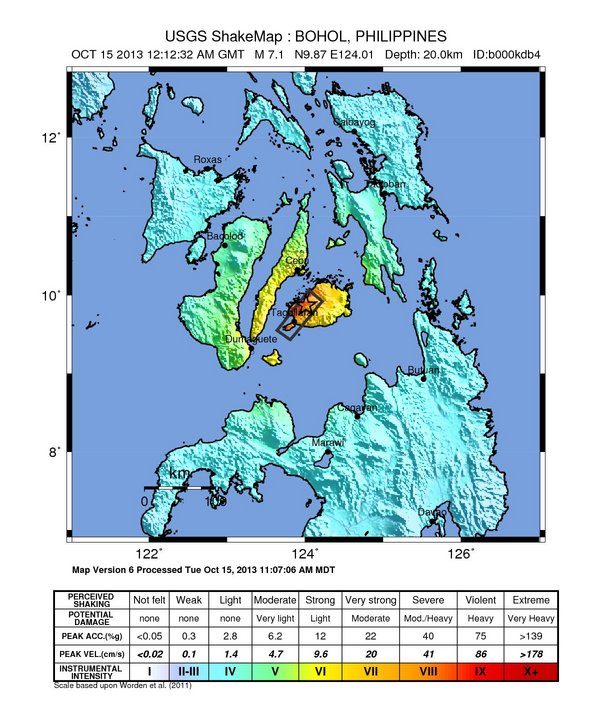
On the morning of 15 October 2013, at 8:12 a.m. local time, a shallow earthquake struck Bohol island in the central Philippines. The US Geological Survey's final record puts the magnitude at Mw 7.1 at 20 km depth near Catigbian; the Philippine agency PHIVOLCS placed the epicentre 6 km southwest of Sagbayan at 12 km depth. Early reports said Mw 7.2 before the USGS revision. The quake was caused by shallow reverse faulting on a previously unmapped fault — later named the North Bohol Fault — which tore the ground with up to 3 metres of vertical displacement.
Shaking reached intensity VII on the PHIVOLCS scale in Tagbilaran City and parts of Cebu. Centuries-old coral-stone churches collapsed: the churches of San Pedro Apostol (Loboc), Santa Cruz (Maribojoc), and Nuestra Señora de la Luz (Loon) were totally destroyed, with several more partially damaged. Landslides struck 25 villages in Bohol and 13 in Cebu, and some landslides dammed rivers, raising flood fears. Limestone sinkholes and liquefaction appeared across the island.
The national disaster council's consolidated count, as of 3 November 2013, recorded 222 dead, 976 injured, and 8 missing — 195 of them in Bohol, the rest in Cebu and Siquijor. Earlier mid-October reports were lower as isolated towns were reached; this is normal for disaster counting, not a contradiction. Damage reached about 2.26 billion pesos (roughly US$52 million), with 14,512 houses totally destroyed. PHIVOLCS recorded 2,779 aftershocks by 3 November, 75 of them felt. The Pacific Tsunami Warning Center issued a single bulletin: no destructive widespread tsunami threat.
Thirteen years on, Bohol's lesson endures: a shallow quake on a hidden fault can flatten unreinforced masonry in seconds. Expect weeks to months of aftershocks after any large quake, and have buildings re-inspected before re-entering.
Sources & references
- Lagmay & Eco (2014) - The magnitude 7.2 Bohol earthquake, Philippines (NHESS discussion paper)
- USGS - M7.1 Bohol Island, Philippines Earthquake of 15 October 2013 (tectonic summary poster)
- PHIVOLCS - The 15 October 2013 Bohol, Philippines Earthquake: Technical Report (archived EMI copy)
- WHO Philippines - Bohol Earthquake: One year on
- PTWC/NOAA/NWS - Tsunami Information Bulletin No. 001 (15 Oct 2013)
- DG ECHO / ReliefWeb - Philippines Bohol earthquake update (22 Oct 2013)
Impact figures
| Fatalities | 222 |
|---|---|
| Economic damage | $52,060,000 (nominal) |
Figures per cited sources; estimates for older events vary.