Hurricane / Cyclone / Typhoon United States
Hurricane Wilma, 19 October 2005 — the most intense Atlantic hurricane on record
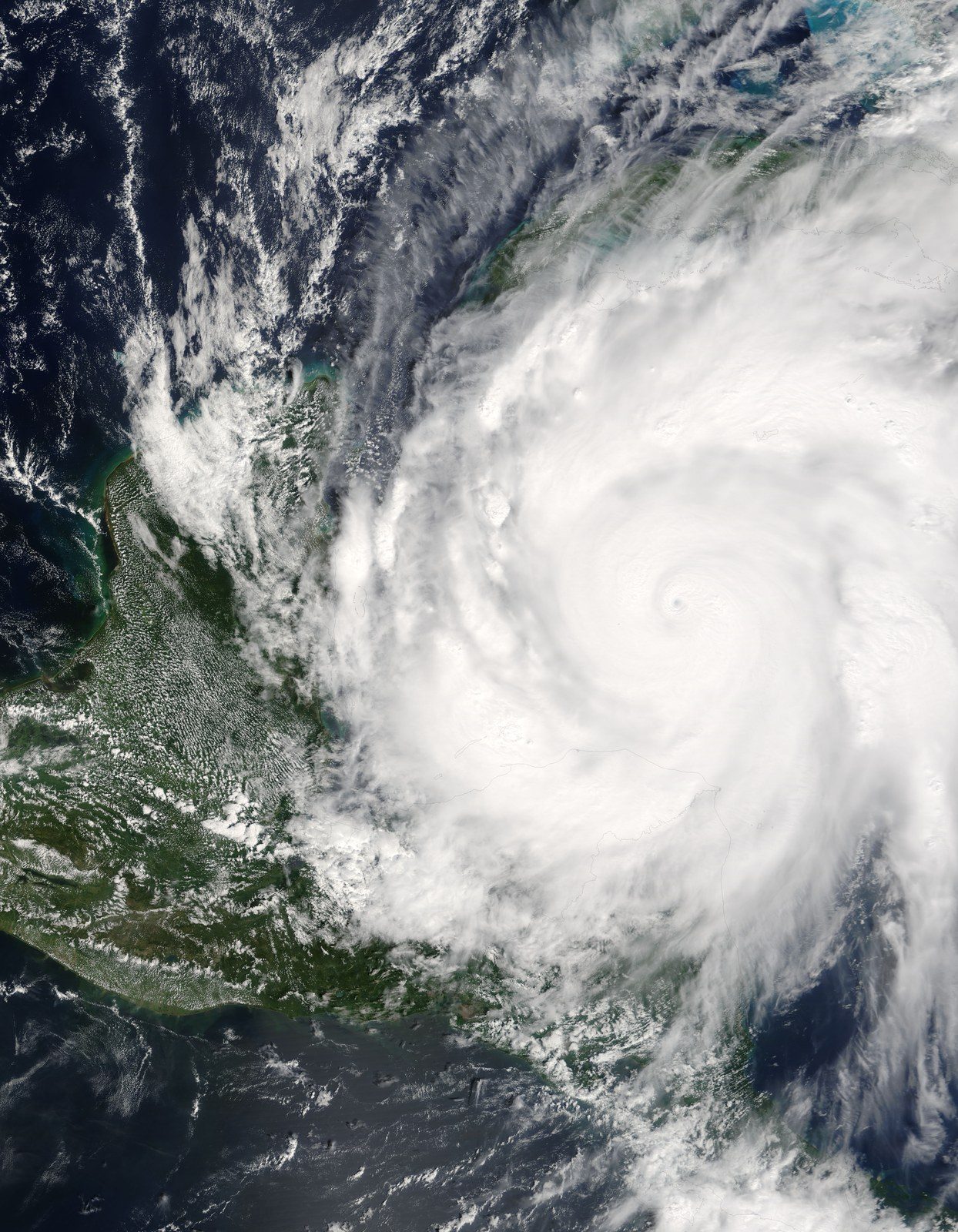
On 19 October 2005, Hurricane Wilma became the most intense Atlantic hurricane ever recorded. "In the span of just 24 hours, Wilma had intensified from a 60-kt tropical storm to a 150-kt category 5 hurricane, an unprecedented event for an Atlantic tropical cyclone," in the words of the National Hurricane Center's Tropical Cyclone Report. By 0600 UTC on the 19th, winds were near 150 kt; around 1200 UTC they peaked at 160 kt, about 185 mph. The estimated minimum central pressure was 882 mb, "a new record low value for a hurricane in the Atlantic basin" — and the report adds that the actual minimum pressure may well have been lower. As it deepened, Wilma's eye contracted to a diameter of 2 nautical miles: "the smallest eye known to National Hurricane Center (NHC) staff."
Wilma had formed as Tropical Depression Twenty-Four on 15 October southeast of Grand Cayman, became a tropical storm on the 17th and a hurricane on the 18th. After the record-setting peak, it held Category 5 status until 20 October, when winds fell to 130 kt and the tiny eye was replaced by one about 40 nautical miles across.
The storm then struck land three times. It made landfall on Cozumel, Mexico, around 2145 UTC on 21 October as a Category 4 hurricane (130 kt), then crossed the northeast Yucatan mainland near Puerto Morelos early on the 22nd, also at Category 4. On 24 October it struck near Cape Romano, Florida, as a Category 3 hurricane with 110-kt winds, then crossed the state in about five hours. Wilma caused the largest disruption to electrical service Florida had ever experienced: the report cites media estimates that up to 98 percent of South Florida lost power, and Florida Power and Light reported outages in 42 counties. Damage was also very severe in the northeastern Yucatan, and storm surge and wave action flooded parts of western Cuba. The system moved out to sea and became extratropical southeast of Nova Scotia around 25–26 October.
The NHC attributes 23 deaths directly to Wilma: 12 in Haiti, 1 in Jamaica, 4 in Mexico, 5 in Florida and 1 in the Bahamas. Unofficial compilations report much higher totals — around 87 — because they add indirect deaths, such as accidents and health events in the storm's aftermath, and country-level reports the NHC does not assess; the report itself notes that detailed information from Mexico was unavailable. For damage, the NHC estimated U.S. losses at $20.6 billion (doubling the $10.3 billion in insured losses), making Wilma the third-costliest U.S. hurricane at the time, behind Katrina and Andrew; a 2011 re-estimate of $21.007 billion placed it fourth, behind Katrina, Ike and Andrew. Unofficial global compilations run near $29 billion because they add Mexico and the Caribbean, which the NHC figures do not cover.
The name Wilma was retired from the Atlantic naming list after 2005, alongside Dennis, Katrina, Rita and Stan. Twenty-one years after the record pressure reading, it still stands — a reminder that a storm's category is only part of the story, and that official warnings are the only reliable guide. Check US weather alerts by state and browse the disaster history archive.
Sources & references
Impact figures
| Fatalities | 23 |
|---|---|
| Economic damage | $20,600,000,000 (nominal) |
Figures per cited sources; estimates for older events vary.